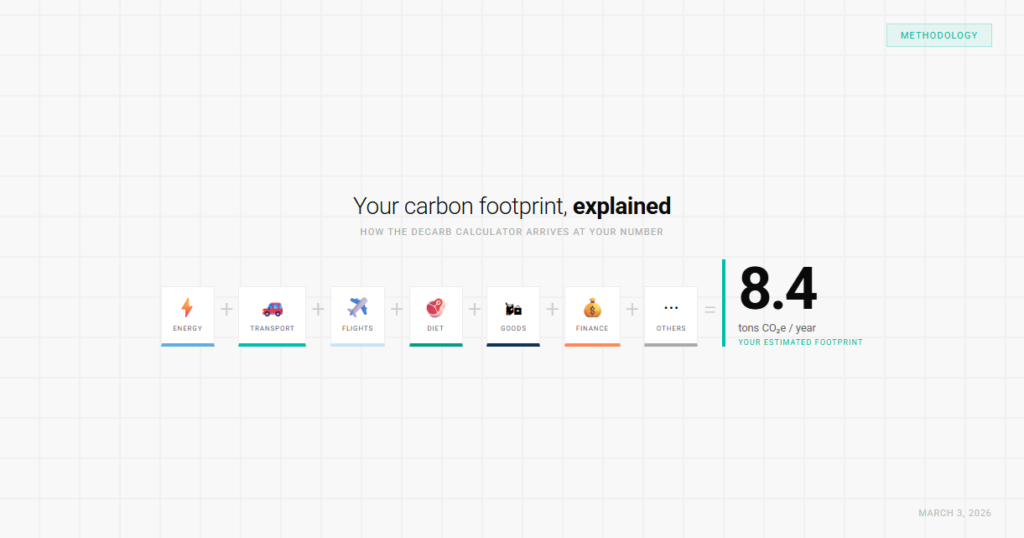
Understanding where your emissions come from is the first step toward reducing them. This post explains exactly how the Decarb calculator arrives at your number — every assumption, every data source, every limitation.
What we measure
The Decarb calculator covers eight emission categories: flights, home energy, food, waste, goods and services, financed emissions, ground transport, and other carbon-intensive activities. Together these account for the vast majority of a typical personal footprint.
Where our emission factors come from
We use verified emission factors from four primary sources.
The IPCC provides global warming potential values and top-level emission factors used across all categories. The IEA provides electricity grid emission factors by country, updated annually. U.S. EPA factors cover transport, waste, and consumption categories for US-based users. Exiobase provides consumption-based emission factors for goods and services.
What we estimate versus what we verify
Not all categories carry equal confidence. Flights, home energy, and ground transport use well-established factors with low uncertainty. Food emissions rely on diet archetypes rather than individual meal tracking — the uncertainty range is wider. Financed emissions use fixed balance assumptions that may not reflect your actual holdings.
We document confidence levels for every category in your report. We will not claim precision we do not have.
Why your number is an estimate
A carbon footprint calculator produces an estimate, not an audit. The accuracy depends on the quality of your inputs and the representativeness of the emission factors applied. Decarb uses the best available verified data, but individual results will vary from reality.
This is not a weakness of the methodology. It is an honest description of what personal carbon accounting can and cannot do at this stage.
What this means for your reduction plan
Estimates are sufficient for prioritisation. If your transport category is three times larger than your food category, that ordering will hold even accounting for measurement uncertainty. The action plan Decarb produces is built on relative magnitude, not false precision.
Want to see how this affects your personal footprint?
Calculate yours in 3 minutes — free, no account required.