
Introduction: A measurable definition
If you are asking what is a carbon footprint, the short answer is this:
A carbon footprint is the total amount of greenhouse gases (GHGs) caused directly and indirectly by an individual, expressed in tons of carbon dioxide equivalent (tCO₂e) per year.
In the United States, the average individual footprint is often estimated between 14–20 tons CO₂e per year, depending on methodology and system boundaries (EPA consumption-based estimates, household modeling tools, etc.).
However, a carbon footprint is not just a number. It is:
- A structured measurement.
- A combination of multiple lifestyle categories.
- An estimate based on emission factors.
- A starting point for continuous reduction.
At Decarb, we define carbon footprint measurement as the foundation for ongoing improvement — aligned with our mission to make personal carbon reduction measurable and continuous.
1. What does a carbon footprint include?
A personal carbon footprint includes emissions from everyday activities across several categories.
According to the GHG Protocol, emissions are typically grouped into:
- Scope 1: Direct emissions (e.g., burning gasoline in your car).
- Scope 2: Indirect emissions from purchased energy (e.g., electricity).
- Scope 3: Indirect emissions embedded in goods, food, services, and investments.
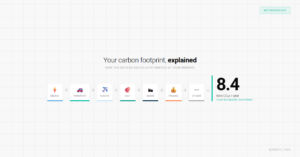
For individuals in the U.S., this translates into eight practical lifestyle categories:
- Flights
- Home energy
- Food
- Waste
- Goods & services
- Finance
- Ground transportation
- Other activities
Each category is measured in tons CO₂e per person per year.

2. Why do we use “CO₂e” instead of just CO₂?
Not all greenhouse gases are carbon dioxide.
Other gases include:
- Methane (CH₄)
- Nitrous oxide (N₂O)
- Fluorinated gases
These gases have different warming effects. To compare them consistently, scientists convert them into a common unit: carbon dioxide equivalent (CO₂e).
The United States Environmental Protection Agency publishes standardized emission factors used to convert fuel, electricity, and waste into CO₂e values.
Using CO₂e:
- Improves comparability.
- Avoids undercounting methane-heavy activities (like landfill waste).
- Maintains scientific integrity.
In Decarb’s system, all results are expressed in tCO₂e/year to ensure consistency.
3. How is a carbon footprint calculated?
A carbon footprint is calculated using:
Activity data × emission factor = emissions
For example:
- 12,000 miles driven in a standard gasoline car
× EPA emissions factor per mile
= ~3.1 tCO₂e/year - U.S. grid electricity use
× eGRID average intensity (~0.42 kg CO₂/kWh)
= home energy emissions - Diet type (vegan vs. omnivore)
× lifecycle assessment factors
= 0.4–2.3 tCO₂e/year
Reputable sources commonly used in U.S.-based footprint models include:
- GHG Protocol
- United States Environmental Protection Agency
- International Civil Aviation Organization
- CoolClimate Network
Decarb’s methodology is built on these sources, prioritizing clarity and avoiding false precision.
4. What drives most carbon footprints in the US?
For many Americans, the largest contributors are:
1. Ground transportation
Standard gasoline vehicle: ~3.1 tCO₂e/year
Large SUV/truck: ~4.5 tCO₂e/year
2. Home energy
Detached home (electricity + gas): up to ~2.5 tCO₂e/person/year
3. Food
Daily meat diet: ~2.3 tCO₂e/year
4. Finance (often overlooked)
Traditional banking + investments: ~6.0 tCO₂e/year
Finance can be one of the largest components because emissions are linked to how capital is allocated (known as “financed emissions”).
This is frequently underestimated in basic calculators.

5. Is a carbon footprint exact?
No.
A personal carbon footprint is an estimate, not a meter reading.
It depends on:
- National averages.
- Household assumptions.
- Emission factors that change over time.
- Simplified user inputs.
The GHG Protocol explicitly recognizes that Scope 3 emissions involve estimation and modeling.
A credible footprint model should:
- State assumptions clearly.
- Avoid exaggerated claims.
- Use ranges when appropriate.
- Distinguish estimates from verified data.
6. What is a “good” carbon footprint?
There is no universal “good” number.
However:
- Global climate goals imply average per-capita emissions must fall to roughly 2–3 tCO₂e/year long term (aligned with 1.5–2°C pathways).
- The U.S. average remains significantly higher.
The key is not perfection.
The key is measurable reduction.

7. Carbon footprint vs. carbon neutrality
A carbon footprint measures emissions.
Carbon neutrality means:
Emissions are reduced as much as possible, and the remaining emissions are balanced through verified removals or offsets.
However:
- Not all “carbon neutral” claims are equal.
- Offsets vary in quality.
- Reductions are more reliable than compensation.
Decarb emphasizes reduction pathways before considering compensation, consistent with our structured, science-based approach.
8. Why measuring your carbon footprint matters
Measuring your footprint:
- Identifies high-impact categories.
- Prevents focusing on low-impact changes.
- Enables year-over-year tracking.
- Supports continuous improvement.
Without measurement, climate action becomes guesswork.
With measurement, it becomes a structured practice — similar to tracking financial spending or physical fitness.
9. Summary: What is a carbon footprint?
A carbon footprint is:
- The total greenhouse gas emissions caused by an individual.
- Expressed in tons CO₂e per year.
- Calculated using activity data × emission factors.
- An estimate, not an exact reading.
- A foundation for structured reduction.
In the U.S., it typically includes emissions from:
- Transportation
- Energy
- Food
- Waste
- Consumption
- Finance
- Flights
- Lifestyle activities
The most effective next step is not abstract concern.
It is structured measurement — followed by prioritized reduction.
→Want to see how this affects your personal footprint?
Calculate yours in 3 minutes — free, no account required.
Start free calculation →Latest posts: